CAPSTONE PROJECT
In May 2025, I finished my education with honors at Parsons School of Design in New York City, with a BBA in Strategic Design and Management.
For my Senior Capstone project, awarded Departmental Honors, I created OGA — a holistic consultancy specializing in luxury hospitality. Developed over the course of one semester, the project focuses on developing a strategic framework for achieving cohesive and impactful brand identities within luxury hotels. The project followed a four-milestone design process, moving from ideation and research to synthesis, prototyping, and final presentation.
Below, you can explore this project as a detailed case study. You can also view the Villa La Madonna Audit, a case developed using the OGA consultancy framework.
• Design Research
• Concept Development
• System Thinking
SERVICES


A Case Study of Senior Capstone Project

In an increasingly competitive luxury hospitality landscape, maintaining a brand identity across all touchpoints has become increasingly complex.This project explores how luxury hotels can preserve a cohesive brand identity holistically in an evolving landscape, and translates these insights into a consultancy model designed to enhance guest satisfaction while maximizing profitability.
MILESTONE 1
RESEARCH
I started with a project statement for OGA that followed:
Supporting luxury hotels in developing cohesive and impactful brand identities that enhance the overall guest experience.
________
To build a strong foundation for the project, I conducted in-depth research using six different methods. This research revealed that brand identity extends beyond visual appeal and is rooted in creating an unforgettable guest experience, shaped by a combination of service, atmosphere, storytelling, technology, and personalization. I also found that the luxury tourism sector is growing and that the lines between hospitality, experiences, and travel services are increasingly blurring, as they are more often brought together under the same roof. The most significant and weighted insights from this research are highlighted in Milestone 1 and outlined below.
KEY TAKE-AWAYS
INTERVIEWS
I interviewed key stakeholders at Villa La Madonna who are directly involved in defining the hotel’s brand identity and guest experience.
KEY TAKE-AWAYS
• Emotional connection is a big part of building a hotel brand
• The importance of building a great team
• Storytelling is a big part of strategy
KEY QUOTES
“A big part of maintaining consistency is having a team that understands the brand.”
– Mikael, CEO
“The strategy is to make it feel like family. It’s important that the guests feel seen and special from the start, which is a big part of our brand strategy.”
– Helen, Brand Director
“We’ve created a destination in the middle of the vineyards. It’s not just a place you happen to pass by; guests make a deliberate choice to come here for the unique experience.”
– Marie, Founder
COMPARATIVE ANALYSIS
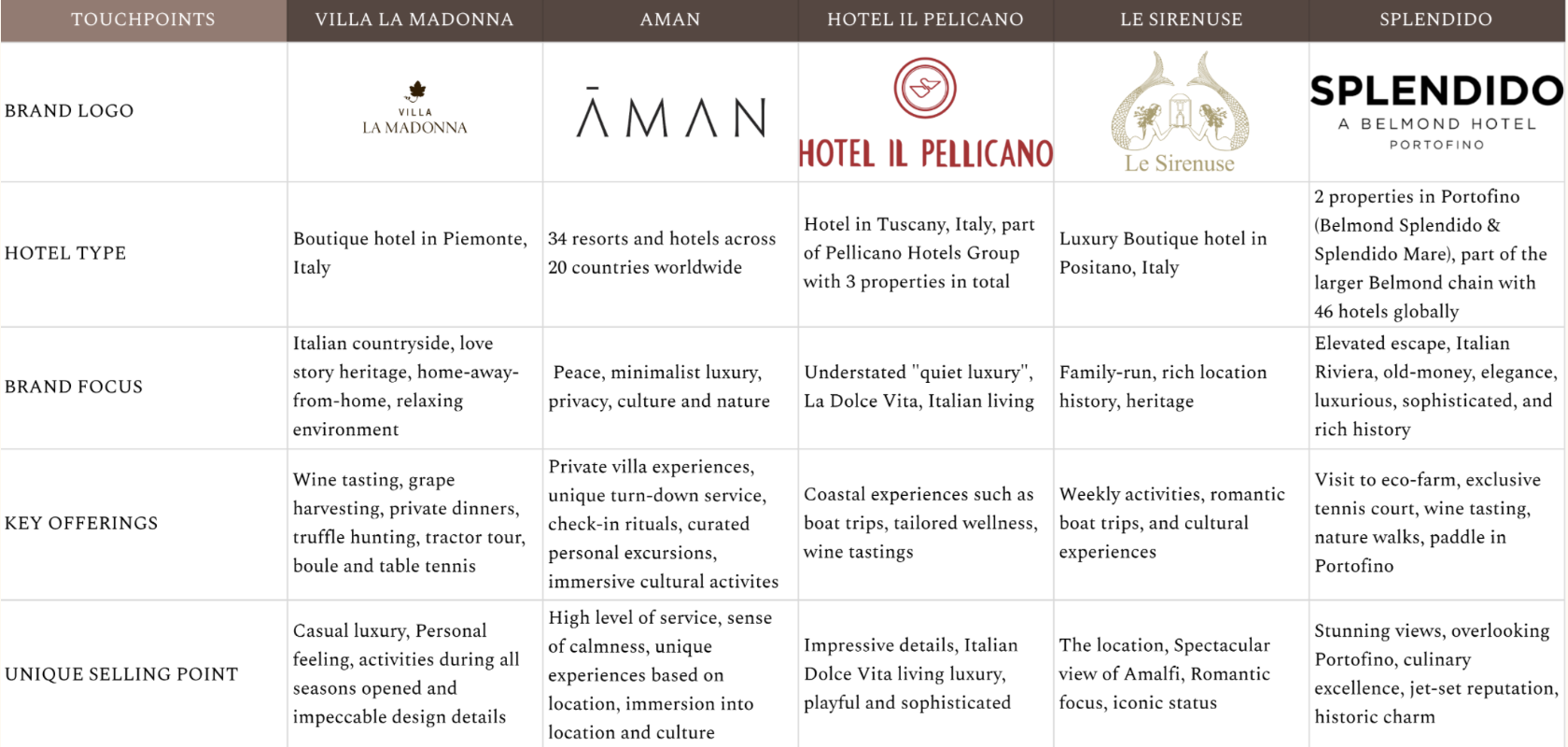
To better understand how luxury hotels differentiate their brand identities, I conducted a comparative analysis of selected properties. By comparing brand focus, key offerings, and unique selling points across hotels, this analysis highlighted how elements such as location, experiences, and storytelling are used in different ways to create distinct guest experiences.
KEY TAKE-AWAYS
• Location and culture being the main factor to what a hotel is offering
• Big emphasis on experiences and heritage
• Personalization exist in all different forms depending on hotel size and location
SECONDARY RESEARCH
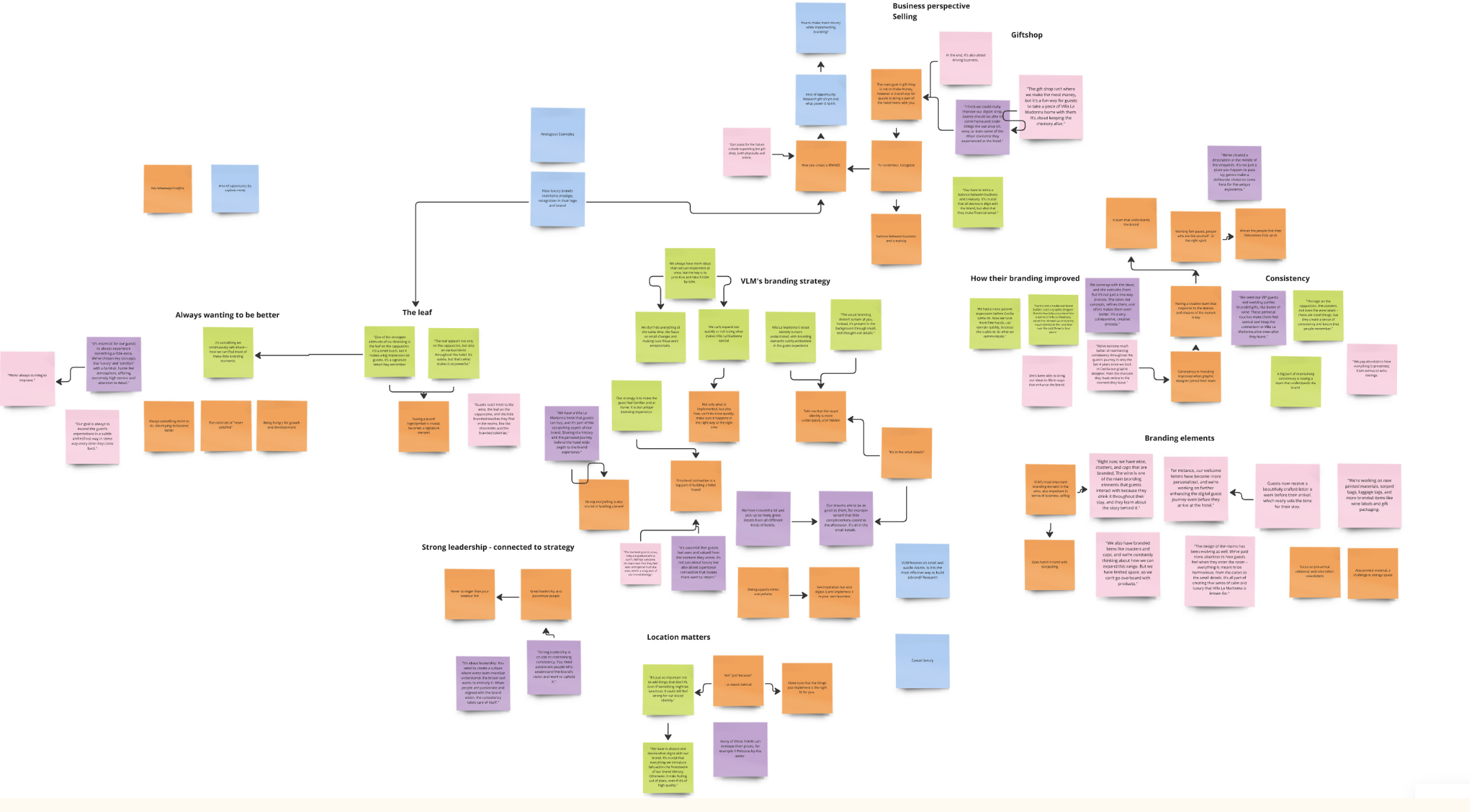
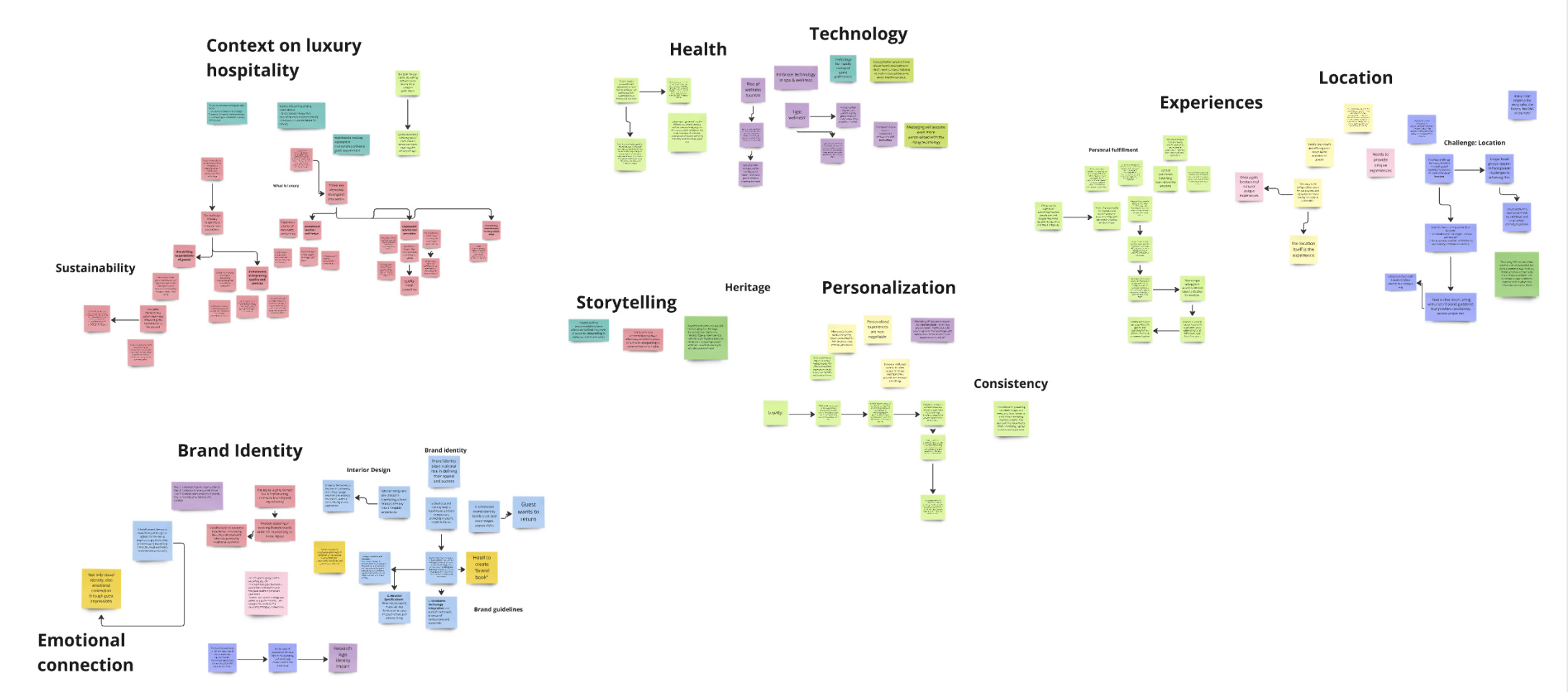
I used Miro to capture, organize, and connect all research findings, allowing patterns, relationships, and key insights to emerge across the different research methods.
KEY TAKE-AWAYS
• Location, experiences, storytelling, technology and personalization are the most impactful features in creating a brand identity
• Crafting a unique brand identity is more than building a visual brand
JOURNEY MAPPING
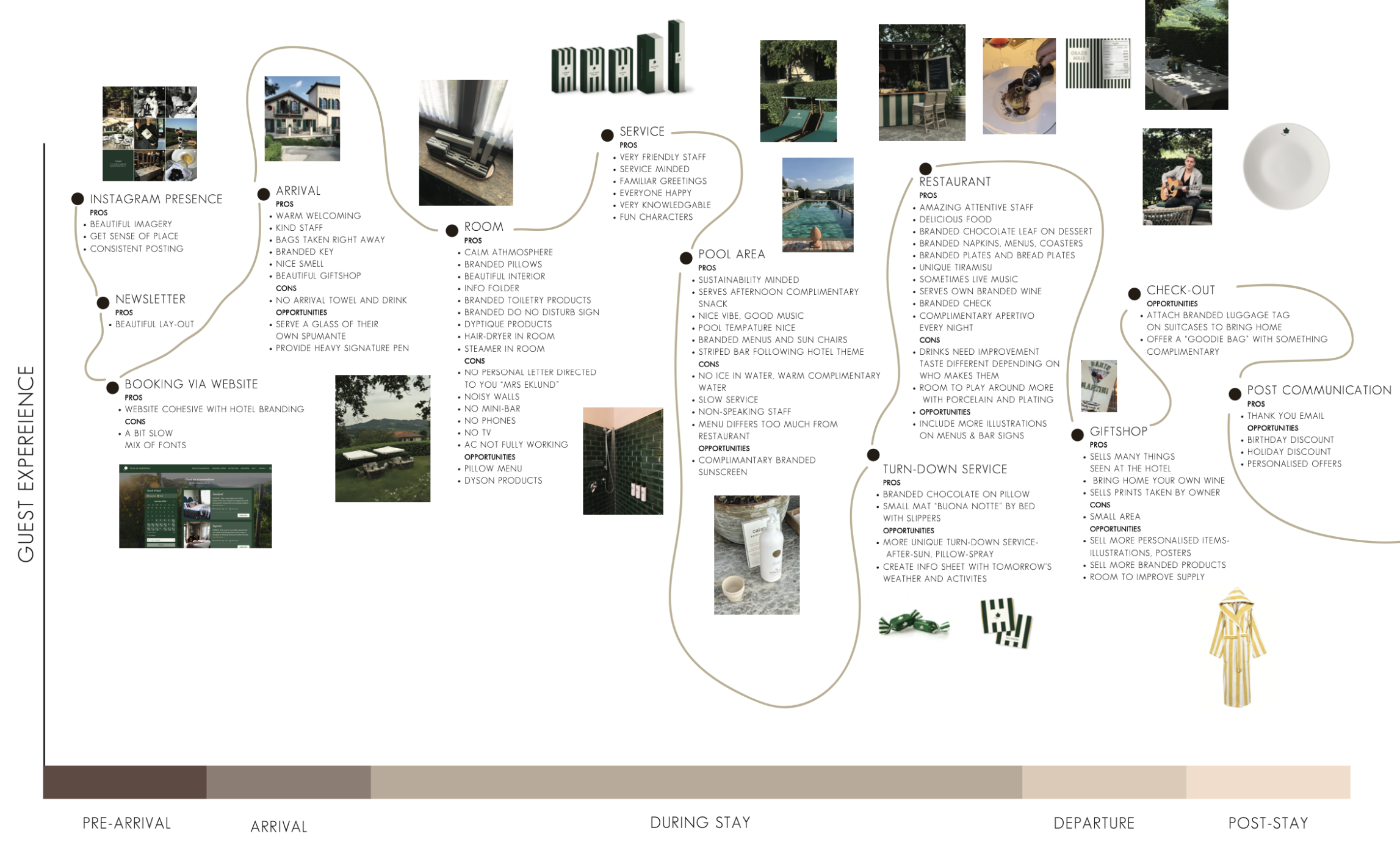
Through an on-site visit, I was able to experience and analyze the hotel from a guest’s point of view. This allowed me to map the guest journey in detail and identify areas of opportunity for improvement, which informed key insights and supported the overall process.
KEY TAKE-AWAYS
• Discovered areas of opportunity to create a stronger brand
• Strong guest interaction with branded bar and gift shop
• Sustainability matters are prioritized
ANALOGOUS EXAMPLES
By studying analogous examples from industries such as fashion, restaurants, and member clubs, I was able to identify how strategies like limited editions, collaborations, meticulous craftsmanship, and recognizable brand codes are used to build strong emotional connections and brand loyalty.
KEY TAKE-AWAYS
• Collaborate with key players in other fields to become more than a hotel
• Integrate “seasonal / limited edition” concepts from fashion into hospitality
• Use a mindset of “meticulous craftsmanship” in every aspect of the brand identity
• Incorporate an iconic pattern to make the brand recognizable
MILESTONE 2
SYNTHESIS
Building on the initial research conducted in Milestone 1, I consolidated all collected information and insights into a set of key findings. Milestone 2 focuses on synthesizing this research across different methods in order to identify patterns, themes, and opportunity areas within luxury hospitality.
A more detailed breakdown of the research, findings, and references can be found in the Appendix.
INSIGHTS & FINDINGS FROM MILESTONE 1
Personalized Experiences are Non-Negotiable
Consistency Is Crucial
Technology Has Rapidly Reshaped Guest Preferences
Constant Development Through Trend Adaptation
Hospitality Is About People
The Location Itself Is the Experience
Rise of Wellness Tourism
Storytelling and Hospitality Are Intertwined
Exclusive Access to Experiences Is A New Differentiator
Sustainable Luxury Evolution
This led me to ask the question:
How might we create a benchmark for achieving consistent brand identity for a luxury hotel, to
create memorable and unique guest experiences?
MILESTONE 3
PROTOTYPING & TESTING
Building on the synthesized findings from Milestone 2, this phase focused on testing how the research could translate into possible solutions. Using a guest-journey–based prototyping method, I mapped the hotel experience over time into three different stages; check-in, stay and room. This allowed me to evaluate which touchpoints guests associate most strongly with luxury, and which elements feel less meaningful or interchangeable. By asking participants to circle and cross out different touchpoints, I was able to validate earlier research findings through direct user input.
A more detailed breakdown of the research, findings, and references can be found in the Appendix.
PROTOTYPE - CHECK-IN
KEY TAKE-AWAYS
• High value is placed on knowing guests’ names
• Provide complimentary drinks and towels
• Personalized check-in experiences
• Airport pick-up shows that luxury guests prioritize convenience
• A beautiful interior is a fundamental part of the luxury experience
• Guests are inclined towards unique check-in rituals and personalized touches
• Many guests favor traditional check-in processes over digital or in-room options
• Implementation of flowers and scent needs to be thoughtfully considered
PROTOTYPE - STAY
KEY TAKE-AWAYS
• Exclusive and impossible-to-access experiences are prioritized
• Guests want access to things that are not widely available, making them feel special and valued
• Extraordinary amenities and lavish spa services are integral to a luxury stay
• Providing guests with access to gourmet or exclusive restaurants can elevate the experience
• Beautiful premises and well-designed spaces are key to creating a memorable stay
• Some guests value a personal butler and effortless relaxation, highlighting the importance of seamless and attentive service
• Items such as room service, buffets, and hotel shuttles are not high priorities for luxury guests and are better positioned as supplementary services
PROTOTYPE - ROOM
KEY TAKE-AWAYS
• Prioritize views and ambiance in room design
• Include wellness-focused options
• Incorporate unique turn-down services with personalized touches
• Provide luxury-branded amenities
• Offer personalized communication
• Make items such as irons, steamers, and extra tech available on request to avoid cluttering the room with less impactful features
FROM INSIGHTS TO FINAL PRODUCT
With a goal to become pioneers in the luxury hospitality sector, by creating such strong value that every luxury hotel wants to work with us.

While many agencies provide surface-level visual branding solutions, OGA delivers a holistic assessment of the entire guest journey; from the first Instagram visit, to the everyday complimentary refreshment by the pool, and months after check-out.
Not only will we maximize the value and profitability of what a hotel already has, but we will also provide fresh ideas to create those small, yet so crucial, moments that hold power.
Final Presentation